Music expresses that which cannot be put into words and that which cannot remain silent”
Victor Hugo, Author
Music is a large part of my life, and influential on my writing. When I hear music, it inevitably takes my mind to either a memory, or helps me shape a story, a feeling, or character. I am transported to a place based on a feeling suddenly forming through my imagination that is guided by the music.
I have learned that my memory is triggered by songs with lyrics, such as songs from the 80s, 90s, or 2000s. That is because the song is pulling me back into a particular moment in my life. The words merely tap my mind to lead me to a memory, or memories, and I am reminiscing, for good or for not-so-good. Perhaps that is one reason I am drawn to music before my time, such as the 40s and 50s.
But classical music is its own environment. Whether listening to Schumann or Chopin, or today’s writers and performers, the sounds of the piano, violin, harp, flute, and guitar all instill a different kind of feeling. Generally, the feeling has nothing to do with the past, but everything with the present, how I feel now. And most important, it helps me picture scenes for my next story, or my poem.
In fact, I write all my poems with classical music playing. Almost as if I can’t have one without the other.
Sometimes, I purposely and purposefully play a specific piece of music to fit with the atmosphere of the poem. When I need a targeted feeling to fully express what I desire in the poem, the emotion I am hoping to pull from the lines, I often know whether it’s Debussy or Rachmaninov who will help me. And then there are other moments I simply let the music play and allow myself an unrestricted movement with my pen to see where the music, and the phrases, take me.
My stories, on the other hand, are a bit different. When I write a story which likely includes music, the music becomes more specific and narrower. I name the symphony or concerto, I listen to it, watch it on YouTube as it is performed by an orchestra, and elicit the emotions I need to give to my character for a specific scene or performance. Often, the music itself, the backstory of the composition, the year it was written, or some other element is interwoven in the story. In other words, I don’t add the piece into the story to fill space. There is a distinct reason I mention it in the story.
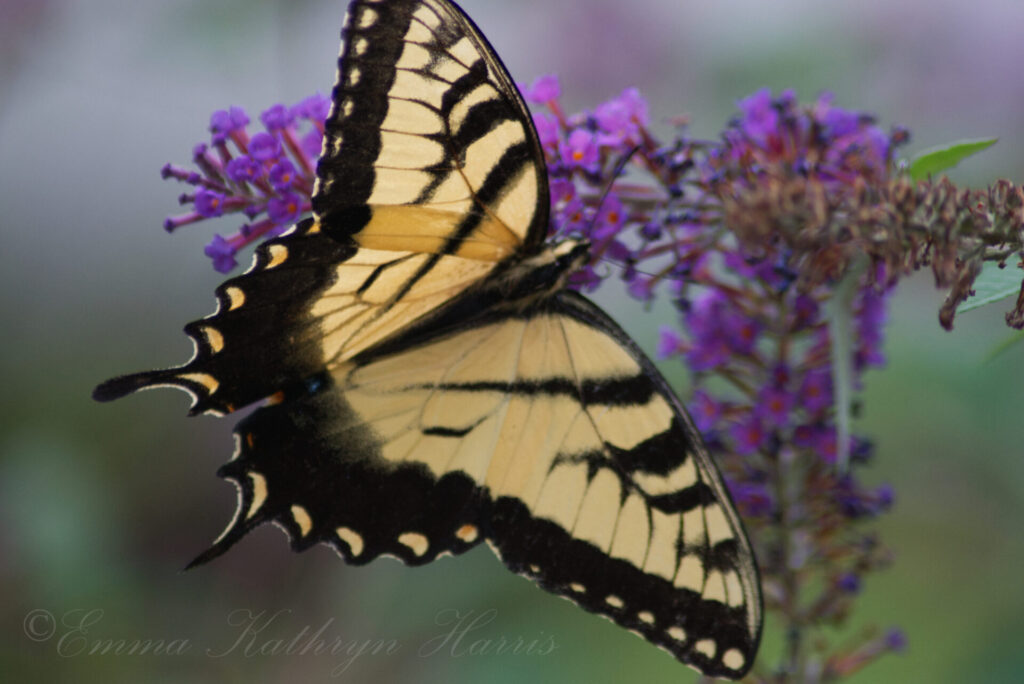
I take moments each day, if possible, to sit on my front porch and observe my garden. The flowers opening and adding color, the bees hopping from one plant to another, the hummingbirds and butterflies dashing and flitting about—I hear music. Not classical music, but the music from birds’ songs, buzzing bees, hummingbirds, and the wind. Before me lies a symphony, and I use creation to compose the story.
Because that is what music is. It is a narrative, told through strings, keys, and brass. The music staff intertwines with the coneflowers and larkspur, before the wind grabs it and pulls it toward the sky.
I see the invisible notes on the invisible staff, just as I see my stories, and characters, and words come to life. And behind all that imagination lies a symphony composed uniquely for my moment that only I can hear, but am honored to share with others through prose.
Follow Emma Kathryn Harris on Facebook and Instagram.

